#1
Best Overall

Five solid-wood boards with no plastic cutting surface, from a budget maple board to a large teak workhorse, and why no rubber or titanium board made the list.
We may earn a commission when you buy through links on this page. Our editorial rankings are maintained separately from retailer relationships.
If you are trying to cut plastic out of your kitchen, the cutting board is a good place to start. Plastic boards scar with use, and research on plastic cutting boards has linked that wear to microplastic particles ending up in food. A solid-wood surface removes the question.
This guide covers five boards, all solid wood. The title names rubber and titanium because shoppers ask about them, and we looked hard at both. Neither material produced a board that clears our evidence bar, and the "Other Options" section explains why.
Picks range from a budget maple board to a large teak board and two end-grain boards. Each one is judged on knife wear, upkeep, stability, cleaning, materials disclosure and value.
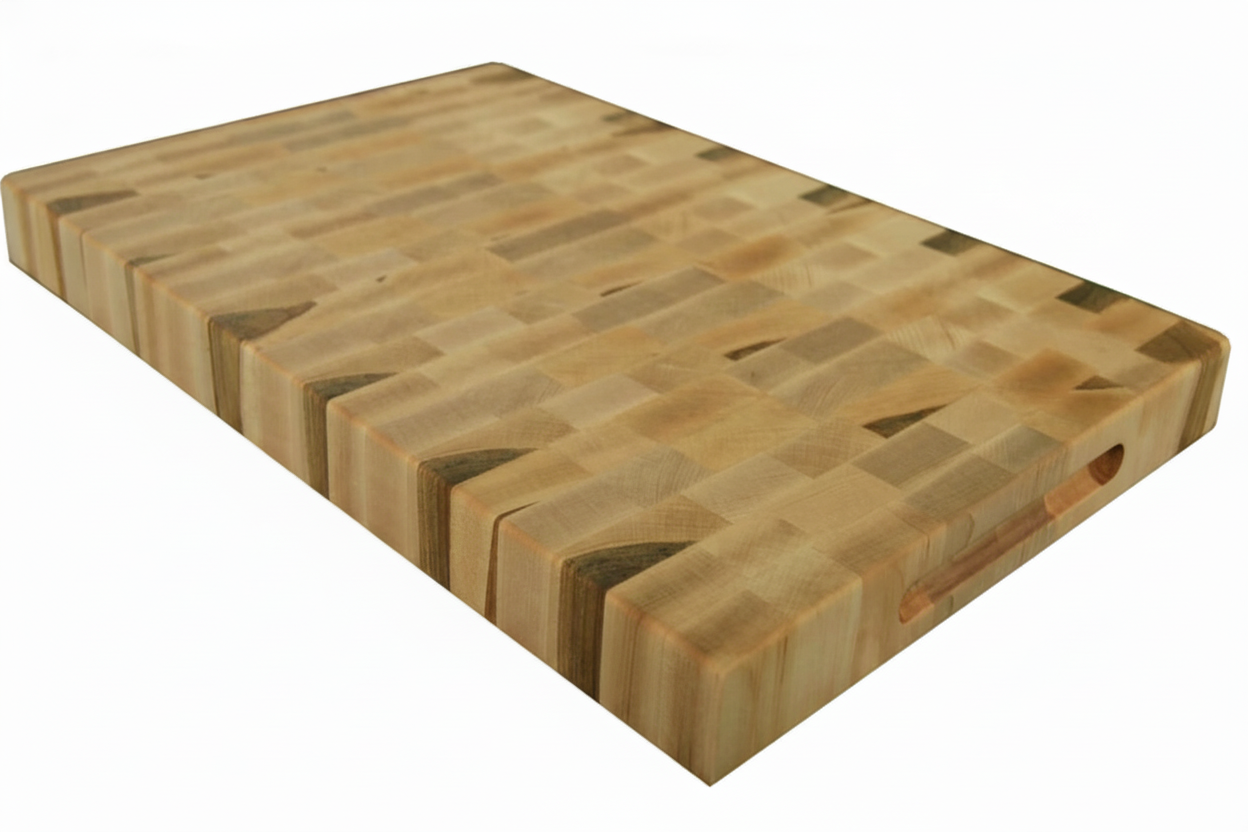
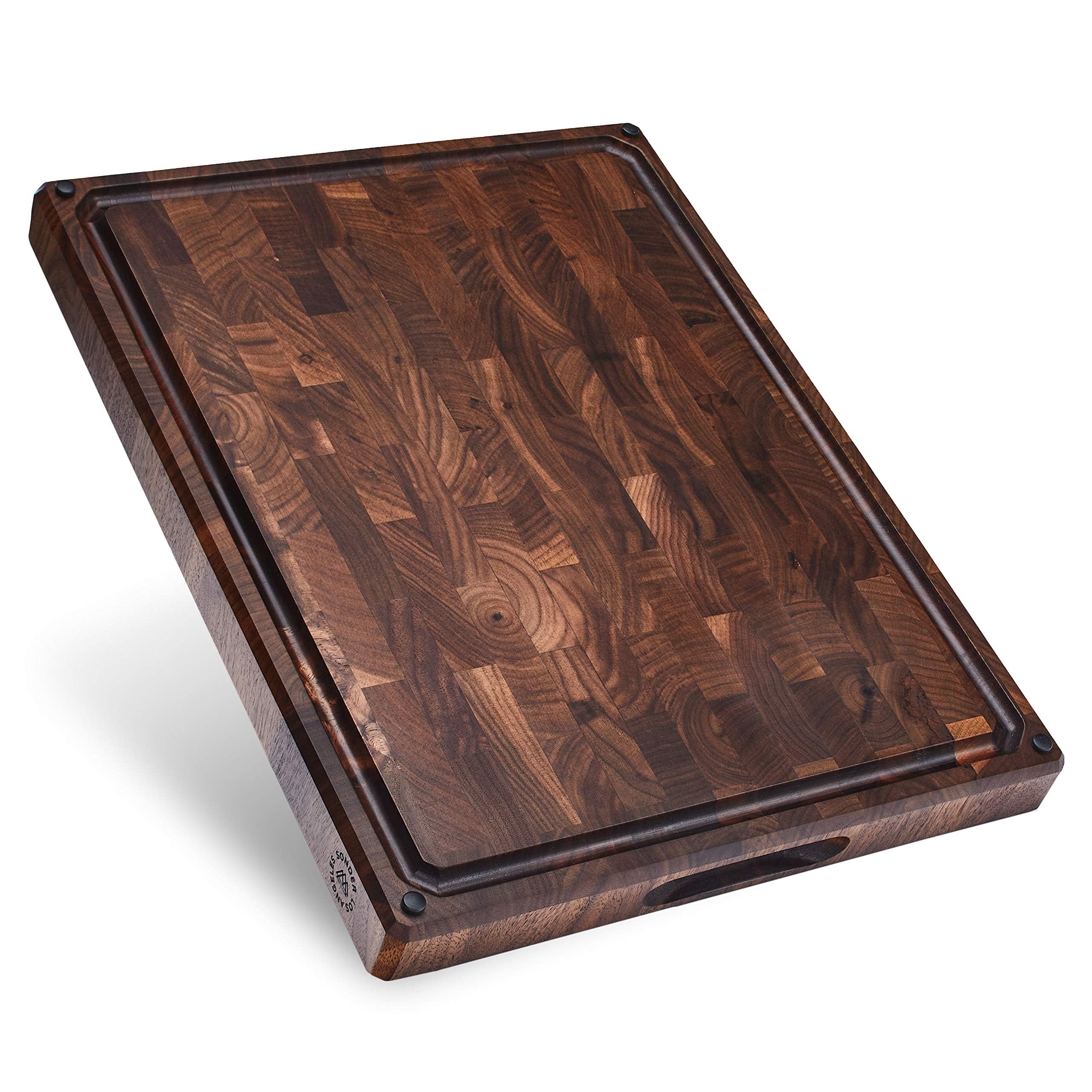

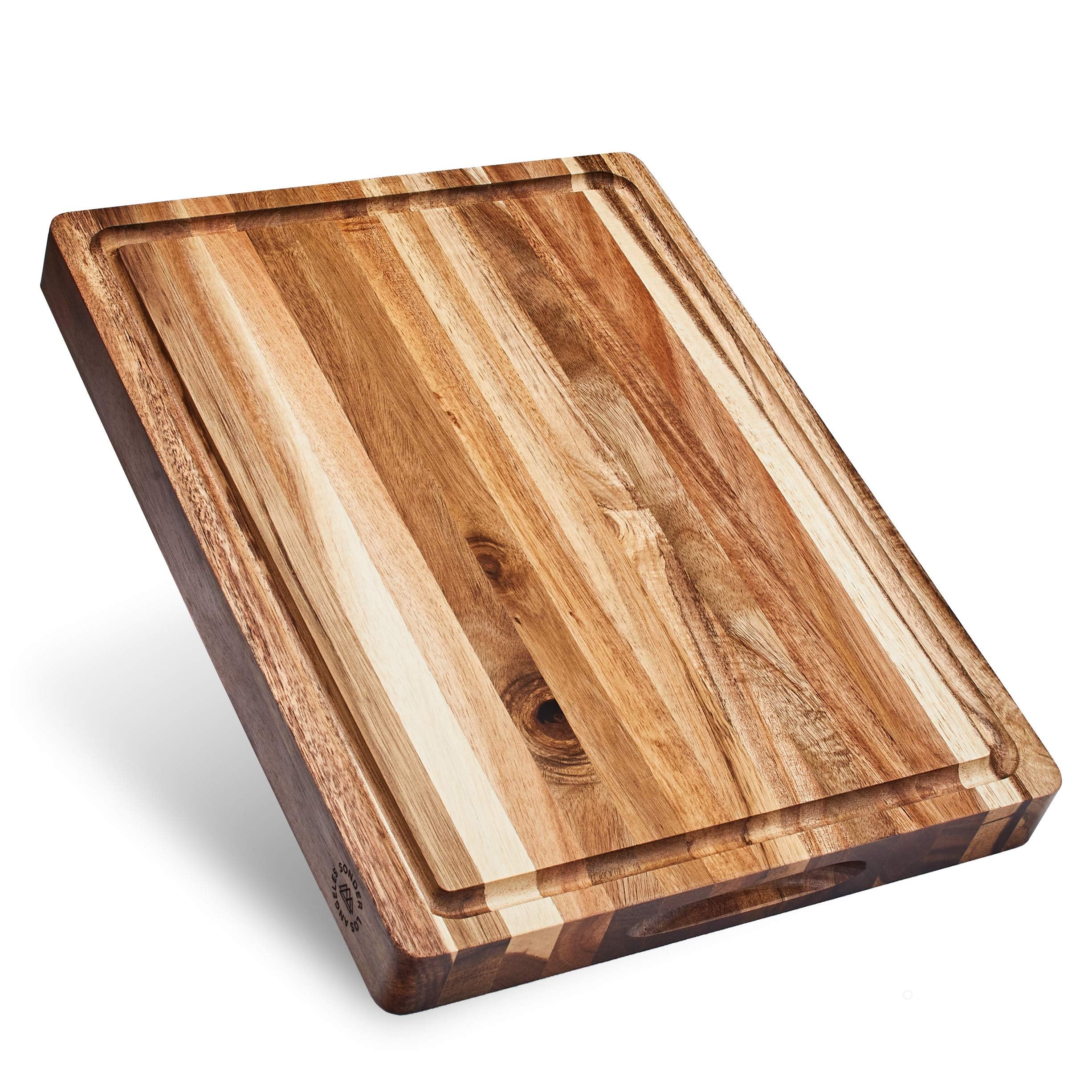
Key specifications and differences across our recommended products.
| Product | Award | Score | Surface material | Construction | Plastic-free cutting surface | Length | Width | Thickness | Lowest verified price |
|---|---|---|---|---|---|---|---|---|---|
| Teakhaus 107 Traditional/Professional Edge Grain 24x18x1.5 | Best Overall | 8.2/10 | Teak | Edge grain, reversible, hand grips | Yes | 24 in | 18 in | 1.5 in | $133.96 |
| Jones Cutting Boards Medium Maple End Grain 16x12x1.5 (ATK model 2000) | Best End-Grain Board (ATK Winner) | 7.8/10 | Maple | End grain | Yes | 16 in | 12 in | 1.5 in | — |
| Sonder Los Angeles Alfred 17x13x1.5 | Best Non-Slip End-Grain Board | 7.4/10 | American black walnut | End grain, juice groove, sorting compartments | Yes | 17 in | 13 in | 1.5 in | $179.99 |
| John Boos Chop-N-Slice 212 (16 x 10 x 1) | Best Value | 6.8/10 | Northern Hard Rock maple | Edge grain, reversible | Yes | 16 in | 10 in | 1 in | $48.95 |
| Sonder Los Angeles Winsome 16x12x1.5 | Best for Serving & Juicy Foods | 6.8/10 | Acacia | Edge grain, juice groove and cracker well | Yes | 16 in | 12 in | 1.5 in | $59.99 |
A huge, stain-resistant teak board that is easy on knives and clear about what it's made of.
Full product review →
A large reversible edge-grain teak board with hand grips, made from FSC-certified teak. It has no plastic surface and a disclosed mineral oil and beeswax finish.
Prudent Reviews named the Teakhaus Professional the best overall cutting board in its lab test. It lost only 36 BESS points of edge sharpness, second best of nine boards. By comparison, the John Boos R-Board lost 174 and titanium boards averaged 444.
It also resisted beet and chipotle stains and kept only a faint garlic smell after one wash. Teakhaus states the teak is FSC-certified and pre-oiled with mineral oil and beeswax, the fullest materials disclosure of any board here. At 24 x 18 inches, it is a premium board but good value per square inch.
Skip it if your counter or cabinet space is tight. At 15 lb with no feet, it is hard to move and store and can slide slightly.
Prices are checked periodically. Older amounts are labeled with their last verification date.
| Retailer | Price | Availability | |
|---|---|---|---|
| Amazon Lowest | $133.96 $139.00 | In Stock | View deal |
America's Test Kitchen's wood winner: a handmade end-grain maple board in a manageable size.
Full product review →
A 16 x 12 x 1.5 inch end-grain maple board handmade in Pennsylvania and sold direct, made to order. It has no plastic surface.
America's Test Kitchen names it its current wood winner. Testers found it quiet and pleasant to cut on, and it survived ATK's dishwasher abuse test. We rate its knife-friendliness highly based on end-grain construction and ATK's tester notes. No edge-loss number exists for this board.
At about 5.6 lb it is far easier to handle and store than the Teakhaus. It is handmade in the USA and sold at a premium mid-range price direct from the maker.
Skip it if you need a board soon. It is made to order with a 40–60 day build time, and the maker does not disclose its glue or finish.
Prices are checked periodically. Older amounts are labeled with their last verification date.
We're still collecting current retailer prices for this product. Check back soon.
A stable end-grain walnut board with feet, a juice groove and sorting compartments.
Full product review →
A 17 x 13 x 1.5 inch end-grain American black walnut board handmade in the USA. Removable rubber feet touch only the counter.
TechGearLab gave it an Editors' Choice for stability. The removable rubber feet grip the counter and keep it from shifting, and the juice groove and compartments make it a practical prep station. The cutting surface is solid walnut.
Prudent measured 75 BESS points of edge loss, fifth of nine boards: better than Boos maple, behind teak. It is in stock on Amazon, so there is no wait.
Skip it if you want full disclosure of materials. Sonder says the board is free of BPA, phthalates and formaldehyde and that the walnut is sustainably sourced, but it names no factory finish or glue and has no third-party certification.
Prices are checked periodically. Older amounts are labeled with their last verification date.
| Retailer | Price | Availability | |
|---|---|---|---|
| Amazon Lowest | $179.99 | In Stock | View deal |
The cheapest well-reviewed, US-made maple board that gets plastic off your counter.
Full product review →
A 16 x 10 x 1 inch reversible edge-grain Northern Hard Rock maple board, made in the USA. It ships with a food-safe oil finish.
It is the least expensive plastic-free board here and has the broadest editorial backing: The Guardian's 2026 plastic-free roundup, NBC Select's best wood board, plus EatingWell and Gear Patrol. It is a straightforward, solid-maple switch from plastic. Boos's own oil is described as food-grade mineral oil with beeswax.
It has not been edge-tested. Prudent tested the thicker Boos R-Board in the same maple, which lost 174 BESS points, so expect it to be harder on knives than the teak or end-grain picks.
Skip it if knife edges matter most or you cook with pigmented produce. EatingWell saw purple carrot pigment on the light maple, and at 1 inch thick it needs hand washing and regular oiling to avoid warping.
Prices are checked periodically. Older amounts are labeled with their last verification date.
| Retailer | Price | Availability | |
|---|---|---|---|
| Amazon Lowest | $48.95 $55.95 | In Stock | View deal |
| Best Buy | Check price at retailer | Check at retailer | Check at retailer |
A thick, affordable acacia board with a juice groove that doubles as a serving board.
Full product review →
A 16 x 12 x 1.5 inch edge-grain acacia board with a deep juice groove and cracker well. No plastic cutting surface.
America's Test Kitchen named it its Best Buy wood board. It showed only minor scratches after testing, and the deep trench and cracker well suit carving a roast or setting out a cheese spread. It is in stock on Amazon at a budget-friendly price.
At 1.5 inches thick, it has more heft than the thinner Boos 212.
Skip it if you want documented materials or easy cleanup. Sonder does not state the finish or glue on the pages we reviewed, and some ATK testers found the trench hard to clean.
Prices are checked periodically. Older amounts are labeled with their last verification date.
| Retailer | Price | Availability | |
|---|---|---|---|
| Amazon Lowest | $59.99 $69.99 | In Stock | View deal |
PickMetric's picks come from research across independent tests, manufacturer specs and owner feedback. We drew on lab-style testing from Prudent Reviews (including its BESS edge-loss measurements), America's Test Kitchen, TechGearLab, The Guardian's plastic-free roundup, NBC Select, EatingWell and Gear Patrol, and checked each maker's own materials and care pages. We evaluated 14 boards.
Scores weight six criteria: knife-friendliness (25%), durability and maintenance (20%), stability and usability (15%), hygiene and cleaning (15%), health and materials (15%) and value (10%). Health and materials rewards a plastic-free food-contact surface, disclosed finishes and glues, and sourcing claims that can be checked. Where a board had no measured edge-loss data, its knife score is an inference and is lower than a measured result would earn.
We started with 14 boards and collected evidence from independent tests, maker spec sheets and owner feedback. The most useful data came from Prudent Reviews, which measured how much sharpness each board cost a knife (BESS points; lower is better). We also leaned on America's Test Kitchen, TechGearLab and plastic-free roundups from The Guardian, NBC Select and EatingWell.
Every pick was then challenged in a structured review before publication, and several changes resulted. The Boos 212 had been credited with a 174-point edge-loss result that actually came from the thicker Boos R-Board, so the guide now describes that as an inference. The rankings were also re-sorted so they match the weighted scores, which moved the Boos 212 down to fourth.
The review also removed an Asahi rubber board and a sold-out Boardsmith end-grain board because their key claims could not be supported. Where glue or finish was undisclosed, we lowered the health-and-materials score and say so in the pick.
For a no-microplastics kitchen, the food-contact surface should be solid wood, with no polyethylene, polypropylene or polymer-composite layer. All five picks meet that bar.
End-grain boards are generally gentler on edges because the knife slides between fibers. In Prudent's test, teak edge grain lost only 36 BESS points, while Boos maple lost 174 and titanium averaged 444. Harder or thinner boards tend to dull knives faster.
A big board gives room to work but is hard to store. The Teakhaus is 15 lb and has no feet. Feet, as on the Sonder Alfred, keep a board in place but make it one-sided.
None of these boards is dishwasher safe. Wash by hand, dry promptly and oil regularly with food-grade mineral oil or a mineral oil and beeswax blend. Neglect leads to cracking and warping, especially in thinner boards.
Look for a named finish, a stated glue and a certification such as FSC. Boards that disclose less are not necessarily unsafe, but you have less to go on.
The main reason to choose wood here is the surface. Research published in Environmental Science & Technology in 2023 (Yadav et al.) found that chopping on polyethylene and polypropylene boards released microplastic particles. A solid wood surface avoids that source.
Boards still involve glue and finish. The Teakhaus lists FSC-certified teak and a mineral oil and beeswax finish. Boos oil is described as food-grade mineral oil with beeswax. Jones, Sonder Alfred and Sonder Winsome do not name their glue or finish on the pages we reviewed. Sonder says the Alfred is free of BPA, phthalates and formaldehyde, but that is a maker statement without third-party certification.
If disclosure matters to you, the Teakhaus is the clearest choice. For any wood board, using plain food-grade mineral oil or beeswax for upkeep keeps the finish simple. If a maker's glue or finish matters to you, ask them directly.
The Asahi Cookin' Cut rubber board did not make the cut. The Amazon listing does not identify a model or formulation, and one retailer describes these boards as synthetic rubber mixed with wood powder, which would make the surface a polymer composite. Some versions use an antibacterial agent that is not named. No independent test of its edge wear exists, so we cannot call it microplastic-free.
The NoTrax Sani-Tuff is a US-made natural-rubber board that can be sanded, but it is out of stock on Amazon and contains an antimicrobial additive that is not disclosed in detail. It is worth a look once restocked if you accept the additive.
Titanium boards, such as the Taima, are plastic-free, but Prudent measured an average 444-point edge loss for titanium boards, the worst of any material, and testers found them loud and slippery. Taima's purity claims have no published certificate.
Boardsmith's maple end-grain board is sold out and its glue is unnamed. Brooklyn Butcher Blocks' walnut board costs much more, and the maker does not disclose finish, glue or thickness. The John Boos R-Board lost the most edge sharpness in Prudent's test and retained stains and odors. The Teakhaus 801 is small and slid in ATK's testing. The John Boos CB1052 is small and collected debris in its juice groove. The Caraway set showed knife nicks and staining in EatingWell's review, and its third-party testing claim names no lab.
Wood has no plastic surface to shed microplastic particles, which is the main concern with scarred plastic boards. Wood needs proper washing, drying and oiling, but it is a sound choice for general food prep.
Yes, if you wash the board by hand with hot soapy water right after use and dry it fully. Teakhaus resisted stains and odors well in Prudent's test. Boards with juice grooves, like the Sonder Alfred and Winsome, help contain liquids.
No. Dishwashers can warp and crack wood. Jones survived ATK's dishwasher abuse test, but the maker does not recommend it, and we would not make it routine.
Teakhaus says to oil 2–3 times a month. As a rule, oil whenever the surface looks dry or pale. Use food-grade mineral oil or a mineral oil and beeswax blend.
Not one that meets our evidence bar today. Rubber boards we found have undisclosed formulations or additives, and titanium boards are hard on knife edges.
The John Boos 212 is the cheapest plastic-free board here. The Sonder Winsome costs a bit more and adds thickness and a juice groove.
For most people with the counter space, the Teakhaus 107 is the best plastic-free board we found: gentle on knives, resistant to stains and openly documented. If you want something smaller and are willing to wait, the Jones end-grain maple is the pick, and the Sonder Alfred is the stable choice you can have shipped quickly. On a budget, the John Boos 212 gets you off plastic for the least money, and the Sonder Winsome suits serving and roasts. If you specifically want rubber or titanium, wait until a board in either material publishes its composition and gets independent testing.